
CMS Posts FY 2027 Hospice Wage Index Final Rule
The FY 2027 Hospice Wage Index and Payment Rate Update and Hospice Quality Reporting Program Requirements [CMS-1851-F] was posted on the Federal Register Public Inspection desk on 7/30/2026 and in the special filings of the Federal Register on 8/3/2026. Providers are strongly encouraged to review the entire content of the final rule as not all detailed information is included in this highlighted summary. These regulations are effective on October 1, 2026.
Payment update information:
- The FY 2027 final hospice payment update percentage is 2.3%. This represents an estimated aggregate impact: +$755 million for FY 2027.
- The final hospice cap amount for the FY 2027 cap year is $36,174.75.
Final FY 2027 Hospice RHC Payment Rates
| Code | Description | FY 2026 Payment Rates | SIA Budget Neutrality Factor | Wage Index Standardization Factor | FY 2027 Hospice Payment Update | FY 2027 Payment Rates |
| 651 | Routine Home Care (days 1–60) | $230.83 | 0.9999 | 1.0010 | 1.023 | $236.35 |
| 651 | Routine Home Care (days 61+) | $181.94 | 0.9999 | 1.0013 | 1.023 | $186.35 |
Final FY 2027 Hospice CHC, IRC, and GIP Payment Rates
| Code | Description | FY 2026 Payment Rates | Wage Index Standardization Factor | FY 2027 Hospice Payment Update | FY 2027 Payment Rates |
| 652 | Continuous Home Care (CHC) Full Rate = 24 hours of care | $1,674.29 | 1.0080 | 1.023 | $1,726.50 |
| 652 | Continuous Home Care (CHC) Hourly Rate | $69.76 per hour* | 1.0080 | 1.023 | $71.94 per hour |
| 655 | Inpatient Respite Care (IRC) | $532.48 | 1.0023 | 1.023 | $545.98 |
| 656 | General Inpatient Care (GIP) | $1,199.86 | 1.0034 | 1.023 | $1,231.63 |
The final FY 2027 rates for hospices that do not submit the required quality data would be updated by -1.7 percent, which is the final FY 2027 hospice payment update percentage of 2.3 percent minus 4 percentage points.
Final FY 2027 Hospice RHC Payment Rates for Hospices That DO NOT Submit the Required Quality Data
| Code | Description | FY 2026 Payment Rates | SIA Budget Neutrality Factor | Wage Index Standardization Factor | FY 2027 Hospice Payment Update (2.3% minus 4 percentage points = -1.7%) | FY 2027 Payment Rates |
| 651 | Routine Home Care (Days 1-60) | $230.83 | 0.9999 | 1.0010 | 0.983 | $227.11 |
| 651 | Routine Home Care (Days 61+) | $181.94 | 0.9999 | 1.0013 | 0.983 | $179.06 |
Final FY 2027 Hospice CHC, IRC, and GIP Payment Rates for Hospices That DO NOT Submit the Required Quality Data
| Code | Description | FY 2026 Payment Rates | Wage Index Standardization Factor | FY 2027 Hospice Payment Update (2.3% minus 4 percentage points = -1.7%) | FY 2027 Payment Rates |
| 652 | Continuous Home Care (CHC) Full Rate = 24 hours of care | $1,674.29 | 1.0080 | 0.983 | $1,658.99 |
| 652 | Continuous Home Care (CHC) Hourly Rate | $69.12 per hour | 1.0080 | 0.983 | $69.12 per hour |
| 655 | Inpatient Respite Care (IRC) | $532.48 | 1.0023 | 0.983 | $524.63 |
| 656 | General Inpatient Care (GIP) | $1,199.86 | 1.0034 | 0.983 | $1,183.47 |
Medicare Non-Hospice Spending
CMS highlights non-hospice Medicare spending as a program integrity concern and links it to the Hospice Service and Spending Variation Index (SSVI).
Key Points
- Total non-hospice spending exceeded $2.8 billion in FY 2024.
CMS reported more than $2.8 billion in Parts A, B, and D spending for beneficiaries enrolled in hospice.
- Part A and B spending increased sharply.
Part A and B non-hospice spending rose from approximately $790 million in FY 2020 to more than $2.0 billion in FY 2024.
- Part D drug spending also increased.
The table below shows annual Medicare-paid Part D spending during hospice elections. Part D spending increased 47% from FY 2020 to FY 2024.
| Fiscal Year | CMS Paid Part D Amount |
| FY 2020 | $552,953,466 |
| FY 2021 | $581,451,662 |
| FY 2022 | $626,486,514 |
| FY 2023 | $728,878,755 |
| FY 2024 | $813,107,802 |
- Beneficiary cost sharing was substantial.
CMS noted that non-hospice utilization may expose beneficiaries to costs they typically would not incur under the hospice benefit.
- FY 2024 spending was concentrated in carrier/physician supply claims.
| Claim Type | FY 2024 Spending |
| Carrier/Physician Supply | $1,562,873,679 |
| Outpatient | $202,855,467 |
| Inpatient | $193,298,218 |
| Durable Medical Equipment | $68,269,227 |
| Home Health | $20,575,467 |
| Skilled Nursing Facility | $17,663,078 |
- Carrier/physician supply claims were the largest growth driver.
- Carrier/physician supply spending increased 317.5% from FY 2020 to FY 2024 and 90.8% from FY 2023 to FY 2024.
- CMS identified pressure-ulcer related claims and skin substitutes as major contributors, with ulcer-related spending increasing from about $18 million in FY 2020 to $714 million in FY 2024.
- For-profit hospice beneficiaries had higher non-hospice spending.
- In FY 2024, beneficiaries receiving care from for-profit hospices had nearly 167% higher non-hospice spending per day than beneficiaries receiving care from nonprofit hospices.
- The disparity increased from approximately 60% in FY 2022, making it a trend CMS intends to monitor.
- FY 2024 spending varied by diagnosis category.
- CMS reported that 30.1% of FY 2024 non-hospice spending was associated with neurological conditions, 25.9% with heart and circulatory conditions, and 67% occurred after hospice election day 60.
| FY 2024 Non-Hospice Spending by Diagnosis Category | ||
| Part A and Part B Spending | ||
| Diagnosis Category | FY 2024 Spending | Share of Part A/B Total |
| Heart/Cerebrovascular | $589,991,573 | 36.2% |
| Neurological/Degenerative | $575,587,784 | 35.3% |
| All Other Diseases | $265,444,840 | 16.3% |
| Cancer | $105,884,608 | 6.5% |
| Respiratory | $95,036,803 | 5.8% |
| Total | $1,631,945,608 | 100.0% |
| Part D Spending | ||
| Diagnosis Category | FY 2024 Spending | Share of Part D Total |
| Heart/Cerebrovascular | $276,254,111 | 34.0% |
| Neurological/Degenerative | $205,128,738 | 25.2% |
| All Other Diseases | $144,939,013 | 17.8% |
| Respiratory | $100,380,848 | 12.3% |
| Cancer | $86,405,092 | 10.6% |
| Total | $813,107,802 | 100.0% |
- CMS compliance and program integrity concerns
- CMS stated that rising non-hospice spending may signal misclassification of related conditions, inadequate coordination, cost shifting, and fragmented end-of-life care.
- CMS specifically noted services and medications that may be related to the terminal condition but billed outside hospice, including wound care, oxygen, bronchodilators, medical supplies, and certain chronic disease medications.
Key takeaway: CMS is positioning non-hospice spending as a future survey, enforcement, and program integrity risk indicator, especially when spending appears related to the terminal illness and should be covered under the hospice benefit.
Hospice Service and Spending Variation Index (SSVI)
The Hospice Service and Spending Variation Index (SSVI) is a new CMS analytical and oversight framework finalized in the FY 2027 Hospice Final Rule. CMS describes the SSVI as a claims-based scoring system designed to assess hospice utilization patterns, identify significant variation among providers, support program integrity efforts, and potentially help beneficiaries make more informed decisions.
CMS developed the SSVI to:
- Monitor hospice service delivery patterns.
- Measure variation in spending and utilization across hospices.
- Identify potential program integrity concerns.
- Detect unusual or outlier provider behavior.
- Support future transparency and oversight initiatives.
CMS stated that reviewing metrics together can reveal patterns that may indicate:
- Inappropriate utilization.
- Minimal service provision.
- Quality of care concerns.
- Potential avoidance of costly services.
- Enrollment of potentially ineligible beneficiaries.
Measures Included in the SSVI
CMS reports that the SSVI is calculated using nine claims-based measures representing hospice utilization and non-hospice spending. The measures include:
- Percent of beneficiaries with a length of stay of 180 days or greater.
- Percent of total discharges that are live discharges.
- Total number of discharges (live or deceased).
- Average minutes of direct patient care per Routine Home Care (RHC) day.
- Average visits per RHC day.
- Percent of RHC weekend days with at least one skilled visit.
- Non-hospice spending per day.
- Percent of live discharges where the beneficiary returns to the same hospice within seven days.
- Total amount of non-hospice spending.
Non-Hospice Spending is a Major Component
CMS places significant emphasis on non-hospice spending within the SSVI methodology.
The agency notes that non-hospice spending exceeded $2.8 billion in FY 2024 and has increased substantially in recent years. CMS specifically incorporated:
- Total non-hospice spending.
- Non-hospice spending per day.
- Eight separate spending thresholds to distinguish varying levels of concern.
CMS states that increasing non-hospice spending may suggest:
- Misclassification of related conditions.
- Inadequate care coordination.
- Potential cost-shifting to other Medicare benefits.
- Failure to provide services that should be included within the hospice benefit.
Examples of Patterns CMS May Flag
CMS explains that individual metrics may not be concerning on their own, but combinations of metrics can indicate elevated risk. Examples provided by CMS include:
| Pattern | Potential CMS Concern |
| Long lengths of stay plus high live discharge rates | Potential inappropriate enrollment of ineligible beneficiaries |
| Frequent live discharges followed by readmission within 7 days | Possible discharge of patients to avoid costly treatments |
| Low visit counts or short visits | Minimal service provision |
| Few weekend skilled visits | Insufficient clinical support |
| High non-hospice spending | Services potentially being shifted outside the hospice benefit |
CMS stated that it already monitors various hospice claims indicators and publicly reports hospice utilization information. The SSVI formalizes these evaluations into a structured scoring methodology that combines utilization, service intensity, discharge patterns, and spending data into a single framework.
The agency specifically notes that such analyses are used to:
- Combat potential Medicare program integrity risks.
- Evaluate hospice behaviors.
- Identify outliers whose patterns differ substantially from expected norms.
The SSVI is best viewed as a hospice program integrity risk score that combines nine claims-based measures, including extensive non-hospice spending analytics, to identify hospices whose utilization and spending patterns differ from expected norms. CMS indicates that the tool will support oversight, transparency, and future program integrity initiatives. CMS also states that the measures and scoring assignment for the SSVI may change over time as they consider
stakeholder feedback and changes in hospice trends.
Final Election Statement Addendum Changes
CMS finalized the proposal to require hospices to provide the Hospice Election Statement Addendum for all hospice elections beginning on or after October 1, 2026. Hospices must furnish the addendum at admission, update it when coverage determinations change, maintain documentation in the medical record, and make it available to beneficiaries, providers, and Medicare contractors as required.
CMS expressed growing concern regarding increased Medicare spending outside the hospice benefit, particularly for services and medications that may be related to the terminal illness and therefore should potentially be covered by the hospice. The agency believes standardized disclosure of coverage determinations will:
- Increase transparency for beneficiaries and families.
- Improve care coordination.
- Reduce confusion regarding coverage responsibilities.
- Support program integrity efforts.
- Encourage appropriate determination of related and unrelated conditions.
Provider requirements include:
- Hospices must provide the Election Statement Addendum to all Medicare beneficiaries at the time of hospice election, rather than only when requested.
- The addendum must clearly identify conditions, items, services, and drugs determined to be unrelated to the terminal illness and therefore not covered by the hospice.
- Hospices must provide a plain-language clinical explanation supporting the determination.
- The addendum must include information on beneficiary rights, including access to advocacy through the BFCC-QIO if the beneficiary disagrees with the hospice’s determination.
- Hospices must update the addendum whenever changes occur that affect determinations regarding non-covered conditions, services, items, or drugs.
- The addendum becomes part of the medical record and must be available to Medicare contractors and non-hospice providers.
- CMS believes the change will improve communication among hospices, beneficiaries, providers, and contractors and may reduce inappropriate non-hospice spending and cost shifting.
A model hospice election statement addendum is available in the Downloads section on the
Hospice webpage at https://www.cms.gov/medicare/payment/fee-for-service-providers/hospice.
Final Clarifying Regulation Text Changes
- Discharge from Hospice Care
Final change to the regulation: CMS finalizes additions to § 418.26(b) to state that the hospice may also obtain the written physician’s discharge order from the physician designee, as defined at § 418.3, or physician member of IDG.
- Face-to-Face Encounter
CMS finalized several technical and program integrity updates to the hospice face-to-face (F2F) encounter requirements used for hospice recertification. The agency revised the regulations at §418.22(a)(4)(ii) to align hospice requirements with statutory changes enacted in the CAA. Key provisions included:
- Extends the allowance for conducting hospice recertification face-to-face encounters via telehealth through December 31, 2027.
- Requires hospices to report appropriate modifiers or codes for telehealth face-to-face encounters.
- Prohibits use of telehealth for the face-to-face encounter in certain program integrity situations involving:
- CMS enrollment moratoriums,
- Enhanced oversight actions, or
- Specified hospice enrollment status concerns under Medicare enrollment authorities.
- The changes are intended to align hospice regulations with statutory requirements while strengthening Medicare oversight and reducing vulnerabilities to fraud, waste, and abuse.
CMS finalized the proposed face-to-face encounter provisions extending telehealth flexibility for hospice recertification encounters through December 31, 2027, while adding coding requirements and restricting telehealth use for hospices subject to specific Medicare program integrity actions. These changes become effective October 1, 2026.
CMS states the G-code along with its reporting guidance and instructions will be issued prior to implementation of this requirement, which does not take effect until January 1, 2027. Further, the use of the G-code is not intended to be used to check provider identification or enrollment status. We note that hospices that are already enrolled in Medicare can continue to utilize telehealth to conduct recertification face-to-face encounters and are not impacted by the home health and hospice nationwide moratorium. We issued clarification regarding the home health and hospice nationwide moratorium and its impact on the hospice face-to-face telehealth flexibility, which can be found at https://www.cms.gov/files/document/hh-hospice-moratorium-faqs.pdf.
Requests for Information (RFI) on Medicare Services and Payment Structure
- Request for Information on Ways to Enhance the Provision of Palliative Care Outside of Hospice Care: Current Coverage, Billing Practices, and Opportunities for Improvement
Request for Information: Enhancing Palliative Care Outside of Hospice Care
In the FY 2027 Hospice Final Rule, CMS summarized stakeholder feedback received in response to its Request for Information (RFI) on ways to improve access to community-based palliative care services outside the Medicare Hospice Benefit. CMS sought input on current coverage pathways, billing practices, barriers to access, and opportunities to better support seriously ill beneficiaries who may not yet be eligible for or choose hospice care.
Key Themes From Stakeholder Comments
- Strong support for expanding access to community-based palliative care, particularly for beneficiaries with serious, chronic, or life-limiting illnesses who have unmet symptom management and care coordination needs.
- Commenters noted that current Medicare coverage is fragmented, requiring providers to piece together services through existing physician, practitioner, and care management benefit categories.
- Many stakeholders identified billing and reimbursement limitations as barriers to broader adoption of palliative care programs, particularly for interdisciplinary services such as social work, care coordination, caregiver support, and spiritual care.
- Several commenters emphasized the value of palliative care in improving symptom management, patient and family experience, advance care planning, and coordination across care settings.
- Stakeholders encouraged CMS to consider new payment models, demonstration projects, or broader benefit enhancements that would support sustainable delivery of palliative care before hospice eligibility is met.
- Commenters also highlighted workforce, training, rural access, and health equity challenges that can limit availability of palliative care services.
CMS did not propose or finalize any new palliative care payment policies or benefit changes but summarized stakeholder feedback and stated that the information collected will help inform future consideration of policies related to community-based palliative care services.
- Request for Information Regarding Construction of a Hospice Specific Wage Index (please review this section carefully as this is only a high-level summary)
CMS requested stakeholder feedback on whether Medicare should develop a hospice-specific wage index rather than continuing to use the hospital wage index that currently adjusts hospice payments for geographic labor cost differences. CMS sought comments on the feasibility of using hospice-specific labor data, potential data sources, and the operational impacts of such a change.
Key Themes From Stakeholder Comments
- Many commenters agreed that the current hospital wage index may not accurately reflect hospice workforce costs, given differences between hospital and hospice staffing patterns.
- Stakeholders expressed interest in exploring the use of Bureau of Labor Statistics (BLS) data or other hospice-specific labor market information to improve payment accuracy.
- Commenters identified significant challenges related to data availability, reliability, and methodological complexity, particularly because hospice-specific wage data are not collected in the same manner as hospital wage data.
- Several stakeholders cautioned that transitioning to a new wage index could create payment redistributions and operational disruption for some hospices.
- Rural providers and small hospices emphasized the importance of maintaining payment stability and ensuring that any future methodology appropriately reflects workforce shortages and geographic variations.
CMS did not propose or finalize a hospice-specific wage index. The agency summarized stakeholder feedback and indicated that it will continue evaluating the feasibility, data sources, and potential impacts of a hospice-specific wage index for future rulemaking.
- Request for Information Regarding Medical Aid in Dying (MAID)
CMS requested stakeholder feedback on experiences and potential operational challenges related to the overlap between state Medical Aid in Dying (MAID) laws and the Medicare Hospice Benefit. The agency sought information regarding how hospices navigate varying state laws, patient requests, provider participation decisions, and compliance with existing federal requirements.
Stakeholder comments reflected a wide range of perspectives. Commenters discussed the complexity of operating in states where MAID is legal while remaining compliant with federal law. Many emphasized the need for clear guidance regarding hospice responsibilities, patient counseling, documentation, staff training, and communication with patients and families. Others highlighted ethical, legal, and operational considerations that hospices face when caring for patients who inquire about or pursue MAID under state law.
CMS reiterated that federal funds may not be used to provide, pay for, or facilitate activities intended to cause or assist in causing death. The agency collected stakeholder input to better understand emerging issues and the practical challenges hospices encounter in states with MAID laws.
CMS did not propose or finalize any new regulations, payment policies, or operational requirements related to Medical Aid in Dying. The agency summarized stakeholder feedback and indicated that the information received will help inform future policy considerations.
Updates to the Hospice Quality Reporting Program (HQRP)
- Updates Regarding the HOPE
- CMS is continuing implementation of HOPE and developing future publicly reported quality measures.
- HOPE reporting-compliance information and quality measures will appear on Care Compare no earlier than FY 2028 using CY 2026 submission data.
- Future HOPE-based quality measures will be publicly reported after CMS completes data collection, testing, and measure development activities.
- HOPE assessment timeliness threshold:
- To meet the assessment timeliness threshold under the Annual Payment Update (APU), hospices must achieve a timely submission rate of 90 percent or higher for FY2027. This means that 90 percent of all HIS and/or HOPE assessments must be submitted to and accepted by CMS within 30 days of the patient’s admission or discharge date.
- Finalized: Due to the newness of the HOPE assessment along with the migration to the iQIES platform, CMS has granted a waiver to all HOPE assessments dated October 1, 2025, through December 31, 2025, and as a result, all HOPE assessments with a target date in 2025 will be considered timely.
- Proposal to Add an Icon for Hospices on Medicare.gov Compare Tool to Indicate Failure to Meet Reporting Requirements
CMS finalized a new transparency initiative to add an icon to the Medicare.gov Care Compare tool no earlier than FY 2028 for hospices that do not meet HQRP reporting requirements, based on CY 2026 quality reporting submission data.
The icon will identify hospices that either fail to submit required HQRP data or submit less than 90 percent of the required quality data. CMS believes public reporting of reporting compliance will encourage greater accountability, improve data submission rates, and enhance the usefulness of Care Compare as a consumer decision-making tool.
While commenters raised concerns about the potential impact on hospice reputations and the need to ensure patients understand the meaning of the icon, CMS concluded that the benefits of transparency outweigh these concerns. CMS noted that quality reporting compliance is an important indicator of provider engagement in quality measurement and public accountability. They also plan to monitor the number of hospices that continue to meet, and miss, the
HOPE reporting requirements for the APU to understand the effect the icon may have on HQRP
compliance across all hospices beginning in FY 2028.
- Future Measures Update
A Technical Expert Panel (TEP) convened in November 2024 provided input on potential
new or potential HCI indicators and based on that feedback. This report can be found at
https://www.cms.gov/files/document/fall-2024-hqrp-tep-summary-report508c.pdf.
Overall, commenters encouraged CMS to preserve meaningful quality measurement while revising scoring and indicator design to better distinguish true differences in hospice performance. CMS thanked commenters for their thoughts and input into the re-specification of HCI. These comments will be taken into consideration as CMS continues to further develop the revised HCI.
Based on this feedback, along with input from other interested parties and additional analysis of the measure and its indicators, CMS is currently considering making changes to the HCI measure and plans to submit the updated measure to the 2026 MUC list. The aim of re-specifying the HCI measure is to make it more useful and important to providers and consumers.
- Form, Manner, and Timing of Quality Measure Data Submission
Submission requirements are codified at § 418.312.
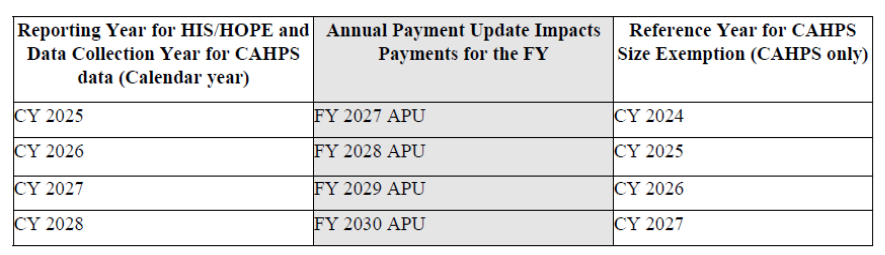
- Submission of Data Requirements
Hospices must submit 90% of required HOPE records within 30 days of each event (admission, discharge, or up to two HUV timepoints based on patient stay) to support quality measures. Most noncompliance occurs due to missing this threshold. Numerous trainings are available online anytime to help hospice staff meet HQRP requirements. For updated resources, visit the HQRP website: https://www.cms.gov/medicare/quality/hospice view training materials at HQRP Training and Education Library, or find more information at Requirements and Best Practices.
HQRP Compliance Checklist
| Annual Payment Update | HIS/HOPE | CAHPS |
| FY 2027 | Submit at least 90 percent of all HIS/HOPE records within 30 days of the event date, for example, patient’s admission or discharge, for patient admissions/discharges occurring 1/1/25-12/31/25. | Ongoing monthly participation in the Hospice CAHPS survey 1/1/2025-12/31/2025. |
| FY 2028 | Submit at least 90 percent of all HOPE records within 30 days of the event or completion date, for example, patient’s admission date, HUV completion date or discharge date, for patient admissions/discharges occurring 1/1/26-12/31/26. | Ongoing monthly participation in the Hospice CAHPS survey 1/1/2026-12/31/2026. |
| FY 2029 | Submit at least 90 percent of all HOPE records within 30 days of the event or completion date, for example, patient’s admission date, HUV completion date or discharge date, for patient admissions/discharges occurring 1/1/27-12/31/27. | Ongoing monthly participation in the Hospice CAHPS survey 1/1/2027-12/31/2027. |
| FY 2030 | Submit at least 90 percent of all HOPE records within 30 days of the event or completion date, for example, patient’s admission date, HUV completion date or discharge date, for patient admissions/discharges occurring 1/1/28-12/31/28. | Ongoing monthly participation in the Hospice CAHPS survey 1/1/2028-12/31/2028. |
For further information, see the CMS Fact Sheet for the hospice final rule.
Questions about the content of this rule? Contact CHAP
Updated Regulatory Text at § 418 – Hospice
§ 418.22 Certification of terminal illness.
(a) * * *
(4) * * *
(ii) During a Public Health Emergency, as defined in §400.200 of this chapter, or through December 31, 2027, whichever is later, if the face-to-face encounter conducted by a hospice physician or hospice nurse practitioner is for the sole purpose of hospice recertification, such encounter may occur via telecommunications technology and is considered an administrative expense. Telecommunications technology means the use of interactive multimedia communications equipment that includes, at a minimum, the use of audio and video equipment permitting two-way, real-time interactive communication between the patient and the distant site hospice physician or hospice nurse practitioner. For face-to-face encounters occurring on or after January 1, 2027, hospices must report any such encounters occurring via telecommunications technology on the claim, in accordance with guidance issued by CMS. Beginning January 31, 2026, telehealth may not be used for the face-to-face recertification encounter if any of the following conditions apply:
(A) The hospice patient is located in an area subject to a hospice enrollment moratorium under section 1866(j)(7) of the Act;
(B) The patient is receiving care from a hospice provider that is subject to enhanced oversight pursuant to section 1866(j)(3) of the Act; or
(C) The face-to-face encounter is conducted by a hospice physician or nurse practitioner who is not enrolled in Medicare under section 1866(j) and is not an opt-out physician or practitioner (as defined in section 1802(b)(6)(D) of the Act.
* * * * *
3. Section 418.24 is amended by revising paragraphs (b)(6), (c) introductory text, (c)(9)
and (10), and (d) to read as follows:
§ 418.24 Election of hospice care.
(b) * * *
(6) For Hospice elections beginning on or after October 1, 2026, the hospice must provide the individual (or representative) an election statement addendum, as set forth in paragraphs (c) and (d) of this section, which includes any conditions, items, services, and drugs the hospice has determined to be unrelated to the individual’s terminal illness and related conditions and would not be covered by the hospice.
* * * * *
(c) Content of hospice election statement addendum. For hospice elections beginning on or after October 1, 2026, the hospice must provide the individual (or representative) an election statement addendum. The election statement addendum (and its updates) must include the
following:
* * * * *
(9) Name and signature of the individual (or representative) and date signed, along with a statement that signing this addendum (and its updates) is only acknowledgement of receipt of the addendum and not the individual’s (or representative’s) agreement with the hospice’s determinations. If the individual (or representative) refuses to sign the addendum, the hospice must document on the addendum the reason the addendum was not signed and the addendum would become part of the patient’s medical record. The addendum must also be available for non-hospice providers and Medicare contractors, although non-hospice providers and Medicare contractors are not required to sign the addendum.
- Date the hospice furnished the addendum to the individual (or representative).
(d) Timeframes for the hospice election statement addendum.
- For hospice elections beginning on or after October 1, 2026, the hospice must provide the individual (or representative) an election statement addendum, in writing, as set forth in paragraph (c) of this section, at the time of the hospice election (that is, within the first 5 days of the effective date of the hospice election). The hospice must also file this information with the election statement, as set forth in paragraphs (a) and (b) of this section, to be available for the individual (or representative), non-hospice providers, and Medicare contractors.
- If there are any changes to the plan of care during the course of hospice care that impact the addendum determinations, the hospice must update the addendum, within 3 days, with the contents described in paragraph (c) of this section, and provide these updates, in writing, to the individual (or representative), as well as update the addendum on file in order to communicate these changes to the individual (or representative), non-hospice providers, and Medicare contractors.
- If the individual dies, revokes, or is discharged within the required timeframe for providing the addendum (and its updates) (as outlined in paragraphs (d)(1) and (2) of this section), and before the hospice has provided the addendum (and its updates), the addendum would not be required to be provided, in writing, to the individual (or representative). The hospice must note the reason the addendum (and its updates) was not completed and/or provided, in writing, to the individual (or representative) and this note would become part of the patient’s medical record. If completed, the hospice must still file the addendum (and its updates) with the election statement, as set forth in paragraphs (a) and (b) of this section, to be available for the individual (or representative), non-hospice providers, and Medicare contractors.
- If the individual dies, revokes, or is discharged prior to signing the addendum (or its paragraph (c) of this section), the addendum would not be required to be signed in order for the hospice to receive payment. The hospice must note (on the addendum itself) the reason the addendum (and any updates) was not signed and the addendum would become part of the patient’s medical record.
* * * * *
4. Section 418.26 is amended by revising paragraph (b) to read as follows:
§ 418.26 Discharge from hospice care.
* * * * *
(b) Discharge order. Prior to discharging a patient for any reason listed in paragraph (a) of this section, the hospice must obtain a written physician’s discharge order from the hospice medical director (or physician designee, as defined at § 418.3) or physician member of the interdisciplinary group. If a patient has an attending physician involved in his or her care, this physician should be consulted before discharge and his or her review and decision included in the discharge note.